
Cash flow
Know what cash is available, what is spoken for and what could change next.
RunwayCal brings cash, known obligations, commitments, revenue timing and plans into one place so you can understand the cash position behind the next decision.
- Held cash
- Known obligations
- Revenue timing
- Scenario impact
Expected money stays separate from held cash until it is received. This is explanatory, not product UI or a literal formula.
Chapter 01
The bank balance tells you what is there. Not what is already spoken for.
Cash in the bank is the starting point. Payroll, tax, tools and contracts may already be coming due, while a customer payment can be expected without having arrived.
RunwayCal keeps those states separate so a held balance is not mistaken for unused credit, expected revenue or cash that is automatically safe to spend.
Understand True Cash PositionFour parts of the cash question
Chapter 02
Expected money should help the plan without pretending it has arrived.
A modeled revenue line, a won deal and a customer receipt are not the same state. Expected amount and collection timing can inform the plan while received cash remains the confirmed event.
This lets the team ask what happens if a receipt is late without quietly adding that money to today's held cash.
Chapter 03
Know what the business has already committed to.
A decision can look affordable until the costs already coming due are put beside it. Keep known commitments in view before another hire, contract or purchase joins them.
Cash Commitments uses structured entries. It does not discover obligations through a general bank feed or automatic reconciliation process.
Explore Commitment PlanningChapter 04
The same amount of money can create a different outcome when the timing changes.
A customer payment expected after payroll cannot cover payroll today. Renewals, tax and one-time purchases create the same timing question. Put the sequence beside the amount before deciding what the cash can support.
The sequence is illustrative. No dates or product state are being claimed.
Chapter 05
Test the decision before you make it part of the plan.
Test one change at a time: hire one person, delay a purchase, change revenue timing, or add or remove a recurring cost. The result shows the consequence of that assumption without rewriting confirmed reality.
A scenario stays hypothetical until you choose to make the change part of the operating plan.
Explore Scenario PlanningAlready belongs in the forward cash view.
Stays separate until the business adopts the change.
Before committing cash
Questions you should be able to answer before committing cash.
- 01
How much cash is actually held today?
- 02
What obligations are already coming due?
- 03
Which customer receipts are expected but not yet received?
- 04
What changes if a payment arrives late?
- 05
What does a new hire or recurring cost do to runway?
- 06
Which assumption is driving the change?
Product evidence
See the cash decision in the product.
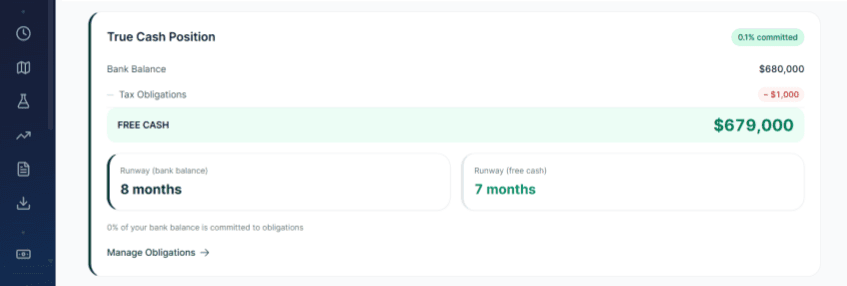
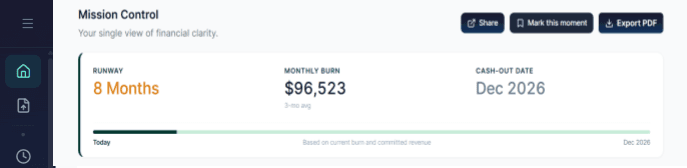
Mission Control keeps the bank balance, recorded obligation context and derived True Cash Position visible as separate values. Runway remains a downstream planning horizon, not a promise about the future.
Make the next decision
Make the next cash decision with the obligations and timing in view.
Start with the cash the business has, keep expected money separate, and test what the next commitment could change.