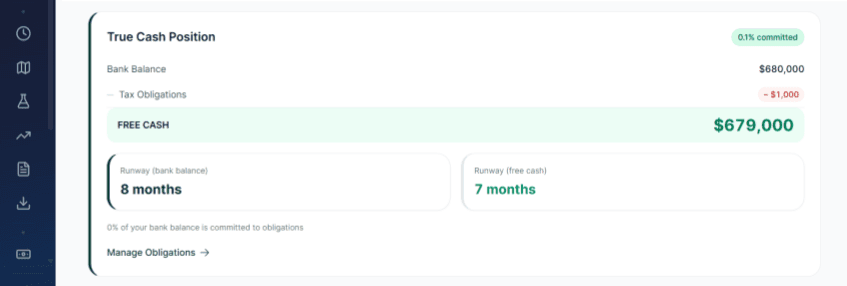
Bank balance is not runway.
Your bank balance includes money that's already spoken for: next month's payroll, quarterly tax payments, that annual software renewal coming up. Most companies look at their bank account and feel comfortable. RunwayCal deducts every committed obligation automatically so you see what you can actually spend, not what the bank shows. The difference between bank balance and True Cash Position can be the difference between 12 months of runway and 5.
- Tax obligations
- Deferred revenue
- Committed payroll
- Vendor commitments
Your bank account is lying to you.
$680,000 in the bank feels comfortable. But subtract $74,000 in upcoming tax obligations, $122,000 in deferred revenue you have not earned yet, and $98,000 in committed payroll. Your true cash is $386,000. Your real runway is 5.2 months, not 12. Every financial decision you make based on bank balance alone is built on a number that overstates your actual position. True Cash Position corrects that by deducting every obligation you've committed to, giving you the number you can actually rely on for hiring, spending, and fundraising decisions.
What happens when you trust the bank balance
You hire based on bank balance, commit to salaries you can't sustain, and run out of cash 6 months earlier than expected. The bank balance gave you a false sense of security because it didn't account for $74K in tax obligations and $98K in committed payroll due within 90 days.
You report runway to your board without accounting for obligations. The board makes strategic decisions based on 12 months of runway when the real number is 5.2 months. By the time the obligations come due and the real runway becomes apparent, you've already committed to plans you can't afford.
You miss your fundraising window because apparent runway looked comfortable. Founders typically need 6 months to raise a round. If your True Cash Position shows 8 months but you think you have 14, you start the fundraise too late and end up raising from a position of desperation instead of strength.
The difference changes everything.
What Your Bank Shows
$680,000
Bank balance
What Is Actually Available
How RunwayCal computes True Cash Position
Bank balance minus every obligation
RunwayCal starts with your treasury balance across all bank accounts. Then it deducts every committed obligation: upcoming tax payments, payroll commitments, cash commitments like annual contracts and lease payments, and deferred revenue that belongs to customers. The result is what you can actually allocate toward growth, hiring, or operational spending. This calculation updates automatically as you add or modify obligations in any module.
Tax obligations deducted automatically
GST, TDS, estimated quarterly payments, state withholding, advance tax. RunwayCal supports tax calendars for 6 jurisdictions and tracks every obligation with due dates and amounts. These obligations appear as deductions from your True Cash Position so you never accidentally spend money that's owed to the tax authority. Mark obligations as paid and the deduction is removed. The connection between tax tracking and cash position is automatic.
Payroll and commitments reflected in real time
Your team page defines every employee with salary and benefits. Your cash commitments page tracks every recurring and one-time obligation. Both feed into True Cash Position as deductions. Add a new team member and your True Cash Position adjusts immediately. Sign a new annual contract and the committed amount is deducted from available cash. Every financial commitment you enter reduces the number you see, keeping it honest and actionable.
Runway computed from True Cash, not bank balance
RunwayCal's runway calculation uses True Cash Position as the starting point, not your bank balance. This means your runway number already accounts for every obligation. When you tell your board 'we have 8 months of runway,' that number reflects the cash you can actually deploy divided by your monthly burn. No hidden obligations will surprise you later. The runway number is defensible because it starts from the most conservative, most accurate measure of available cash.
Why it matters for every financial decision
Every decision you make depends on knowing what you can afford. Can you hire that engineer? Can you commit to a 12-month lease? Should you start fundraising now or wait 3 months? True Cash Position gives you the correct starting point for every one of these decisions. Without it, you're making commitments based on a number that includes money you've already promised to someone else. With it, every financial decision starts from reality.
Related terms:True Cash Position·Runway·Burn Rate·Deferred Revenue