
Agencies & Consulting
Projects · Invoices · Contractors
Know what every project is doing to the business.
Projects can move ahead while invoices wait and delivery costs keep moving. Connect project revenue, collection timing, consultants, contractors, and cash before the next decision.
Agency financial reality
Delivery moves first. Cash often follows later.
Pipeline is not sold work. Sold work is not delivered work. Delivered work is not collected cash. Keep every state visible while people cost moves.
Illustrative project-to-cash chain
Revenue, delivery, and cash are not one number.
pipeline → delivery → collection
- 01
Pipeline
Possible work, not sold revenue
- 02
Sold work
Contracted work enters the delivery plan
- 03
Delivery capacity
People determine what can move
- 04
Work delivered
Delivery and cash remain separate
- 05
Billed
The collection clock begins
- 06
Cash collected
Received cash reaches the financial position
People cost runs through the chain
- Payroll
- Contractors
- Tools
- Operating commitments
Projects, invoices & collections
Follow the work all the way to available cash.
Keep Project Value, Committed Revenue, collection timing, and cash in one operating conversation.
- Object
- Projects
- Value
- Project Value
- Pipeline
- Project Pipeline
- Dimension
- Service line
Delivery capacity
See the room between committed work and available capacity.
Capacity is a financial planning input, not a timesheet or scheduling workflow.
- Team capacity
- The delivery room available this period
- 1,000 hrs
- Committed work
- Sold work already asking for capacity
- 820 hrs
- Unallocated room
- Capacity left before another commitment
- 180 hrs
Decision question
Hire now, use contractors, or wait?
Test the cost and timing before capacity becomes a fixed commitment.
Capacity, Consultants & commitments
See the cost of capacity before you add more.
A growing pipeline can support more capacity, but only sold work can carry the plan. Contractors, payroll, and tools may be due before clients pay.
- 01
Consultants & payroll
Recurring delivery capacity
What is already committed before the next client payment?
- 02
Contractors
Project-linked delivery cost
Does the collection plan support the added capacity?
- 03
Software & Tools
Known operating commitments
Which renewals still serve the way work is delivered?
- 04
Other Cash Commitments
Taxes and scheduled outflows
What leaves cash even if an invoice runs late?
Plan & decide
Find the drift. Test the response.
Compare the plan with the recorded result. Keep the variance visible, then test what the next staffing, collection, or delivery decision could change.
Plan vs actual
Turn the difference into a decision.
Review project revenue, delivery cost, and collection timing without treating the status label as the answer.
- Plan
Approved assumptions
- Actual
Recorded period
- Variance
Difference retained
- Next action
Review and decide
Project revenue
- Plan
- Approved project revenue
- Actual
- Recorded period result
- Variance
- Difference retained
- Next action
- Review scope or delivery assumptions
- Status
- Review movement
Delivery cost
- Plan
- Approved staffing and delivery cost
- Actual
- Recorded period cost
- Variance
- Difference retained
- Next action
- Review staffing and capacity
- Status
- Review commitment
Collections
- Plan
- Expected collection timing
- Actual
- Recorded cash receipt
- Variance
- Timing difference retained
- Next action
- Push collection or adjust the cash plan
- Status
- Review timing
Scenarios
What happens if we hire before the next contract closes?
Test a hire, contractor decision, or payment moving by 30 days while keeping the current plan visible.
Illustrative decisions
- 01
Collection slips
How do cash and runway respond if a client pays later?
- 02
Capacity changes
What changes if you add a contractor or Consultant?
- 03
Client work changes
What happens if a large engagement slows or ends?
These are decision examples, not Agency-specific scenario presets.
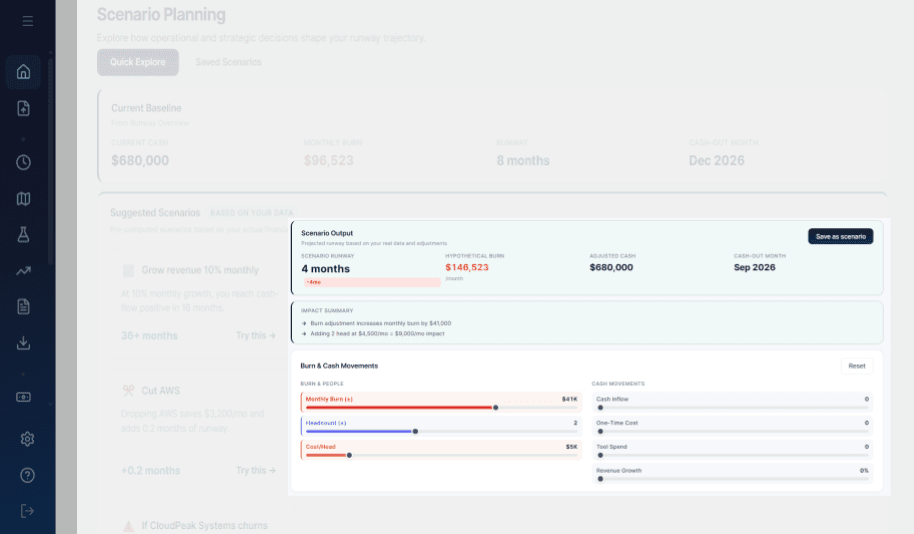
Inside RunwayCal · Scenarios
The visible product supports changing assumptions and comparing runway, burn, cash, and cash-out timing against a baseline.
Product proof
Keep the headline view connected to the underlying decisions.
Mission Control shows the financial position. Planner keeps the operating assumptions visible. Read-only sharing carries the selected view forward.
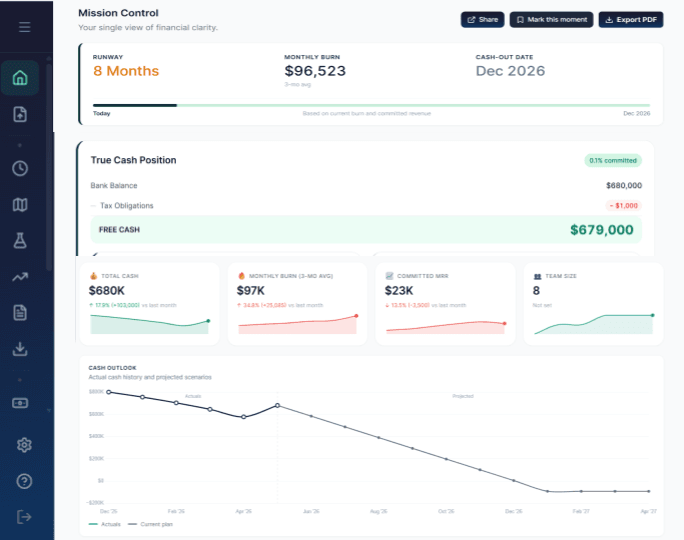
Inside RunwayCal · Mission Control
Start with the cash position and runway.
The visible dashboard brings runway, monthly burn, cash-out timing, True Cash Position, and the cash outlook into one view.
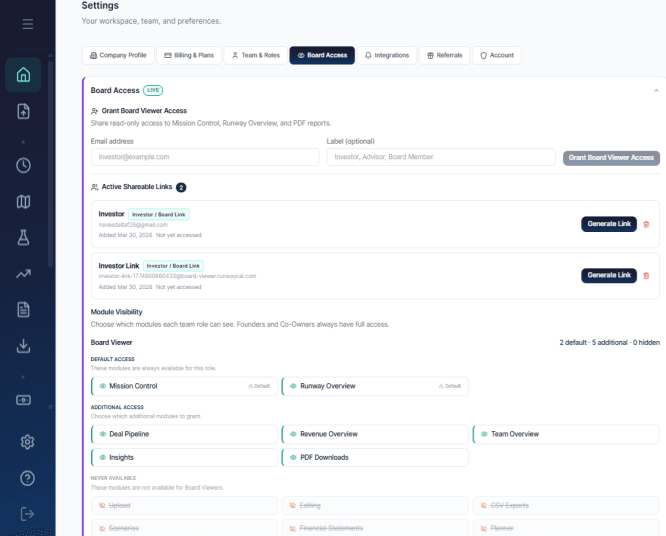
Inside RunwayCal · Board Access
Share a selected read-only view.
The visible settings surface supports read-only viewer access, active shareable links, and module visibility controls.
Reporting & metrics
Use each number to ask a better question.
Give owners, finance leads, and partners the operating context behind collections, capacity, cash, and client exposure.
Explore reporting- Invoice Collection Rate
- Decision question: How much committed revenue has been received?
- Product-evidenced concept
- Collection Speed
- Decision question: Which clients tend to take longer to pay?
- Website language
- Contractor Burn %
- Decision question: How much of the cost base depends on contractors?
- Website language
- Client Concentration
- Decision question: How exposed is the plan to one large client?
- Planning concept
- True Cash Runway
- Decision question: How long can the business operate after known commitments?
- Website language
- Project Margin
- Decision question: Does project revenue still support its direct delivery cost?
- Planning concept
Some measures are visible in the product today. Others are useful planning lenses, not automatic calculations.
Keep planning
Take the project question into the next planning view.
Move from pipeline, capacity, billing, and collection into the decision the business needs to test.
Plan the work without losing sight of the cash.
Connect projects, collection timing, capacity, and commitments before the next decision.