Bootstrapped founders

Know what the business can afford before you make the next commitment.

Customer cash, founder capital, payroll, and commitments all compete for the same limited funds. See what is already spoken for, how long the current path can hold, and whether the next hire or purchase still leaves the business room to adapt.

Inputs
Cash received and cash held
Pressure
Payroll and commitments
Choice
Spend, wait, or change the plan
Conceptual self-funded decision path
Cash heldCustomer cash received
PayrollCommitmentsGrowth spend
DecisionSpend, wait, or change the planRunway and break-even stay visible

Conceptual explanation only. No automatic recommendation.

What can the business afford without giving up its options?

Bootstrapped planning starts with a hard constraint: the business must fund its choices from cash it holds or earns. The aim is not to cut everything. It is to protect payroll, keep commitments visible, move toward break-even, and spend where the business can still absorb a delay.

01Can we afford the next hire?
Put the role, start date, and expected cost beside current payroll before the offer turns into a recurring obligation.
02How long can the current cash carry us?
Read cash held, customer cash received, burn, and dated commitments together. Expected revenue stays outside realized cash.
03Should we spend now, wait, or change the plan?
Compare explicit alternatives without rewriting the current plan, then choose the trade-off the business can carry.

Keep the numbers and choices separate as you work through the decision.

01

Start with cash that is actually in the business.

Cash held and customer receipts already recorded form the current starting point. A sale, pipeline amount, or expected payment remains useful context, but it does not become received cash until a receipt is recorded.

02

Make payroll and commitments visible before adding another one.

People, tools, taxes, and other supported commitments create pressure before the next growth expense arrives. Read that pressure first so a new recurring cost does not hide inside a monthly total.

03

Compare spend, wait, and revenue-late cases.

A scenario can test an earlier hire, a delayed purchase, or customer cash arriving later. Each case stays hypothetical, so the comparison does not overwrite recorded receipts, payroll, or the approved plan.

04

Use runway to protect options, not to postpone every decision.

Runway shows the consequence of the current path. Break-even progress and a useful cash buffer can matter just as much. The goal is to invest deliberately while preserving enough room to respond when timing changes.

Read cash, burn, and runway together before adding another cost.

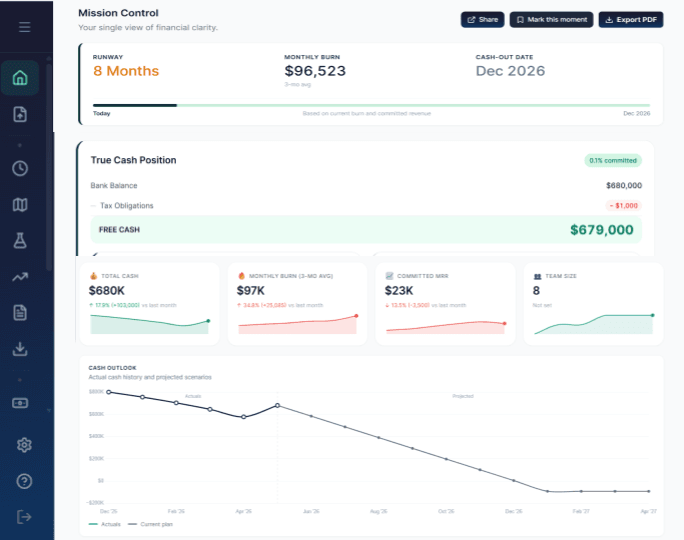
Mission Control places the current cash position, burn, runway, and other supported measures in one review. It does not decide whether the business should hire, cut, or raise.

RunwayCal Mission Control showing True Cash Position, runway, burn, operating metrics, and a cash outlook
RunwayCal Mission Control: current cash, burn, runway, and related measures.

Related numbers can still answer different questions.

Customer cash
Recorded receipts, not an expected sale or unpaid amount.
Commitments
Known payroll, tools, and other supported costs that compete for cash.
Runway
Time created by the current path, not the only goal of the business.

Bootstrapped planning

Make the next commitment with the numbers in view.

See what the business already carries, compare the next choice, and keep enough room to change course.