
Logistics
Fleet · Fuel · Routes
More work only helps if the economics move with it.
Connect booked work, delivery capacity, customer collection timing, drivers, fuel, leases, maintenance, and cash. See what the next contract asks of the financial plan before adding capacity.
Logistics financial reality
Revenue and operating cost move on different timelines.
A contract can create revenue before the customer pays. Fuel, drivers, fleet, and other commitments can start consuming cash at the same time. The timing difference is the financial story.
Money in
Booked work is not received cash
- I1
Booked work
Customer work enters the operating plan
- I2
Available capacity
People and equipment set what can be served
- I3
Delivery / service
The work is completed before every payment arrives
- I4
Invoice
The collection clock begins
- I5
Collection
Expected timing stays separate from cash
- I6
Cash
Received money reaches the financial position
Money out
Operating cost moves independently
- O1
Drivers / people
Payroll follows the capacity plan
- O2
Fuel
Activity can move cost before collection
- O3
Contractors
Flexible capacity still creates cash pressure
- O4
Maintenance
Upkeep keeps its own schedule
- O5
Leases
Vehicle and equipment commitments continue
- O6
Recurring commitments
Known obligations retain their timing
Current financial picture
Cash received, capacity, operating cost, and known commitments meet in one planning view.
Decision context
Take on work, add capacity, or change the operating plan?
Contract economics
A larger contract is not automatically the better cash decision.
Expected revenue is only one part of the decision. Put capacity, fuel, contractor or workforce pressure, maintenance, leases, and collection timing beside the work.
Illustrative contract comparison
A larger contract is not automatically the better cash decision.
Contract A
illustrative- Expected revenue
- Higher expected revenue
- Capacity
- Uses current capacity
- Cost pressure
- Moderate cost pressure
- Collection timing
- Collection expected sooner
Contract B
illustrative- Expected revenue
- Largest expected revenue
- Capacity
- Needs added capacity
- Cost pressure
- Higher fuel and contractor pressure
- Collection timing
- Collection expected later
Contract C
illustrative- Expected revenue
- Lower expected revenue
- Capacity
- Fits current capacity
- Cost pressure
- Lower cost pressure
- Collection timing
- Collection expected sooner
Fleet, fuel & workforce
Operating costs start moving before every customer pays.
Fuel gets paid whether the customer has paid yet or not. Keep fleet payments, maintenance, payroll, equipment, facilities, and other known obligations next to the collection plan.
Fuel
Variable spend can move with work before collection
Drivers & payroll
Workforce timing follows the operating plan
Fleet payments & maintenance
Known vehicle obligations and upkeep
Equipment & Systems
Financing and operating systems already approved
Warehouse / facility
Location costs that continue across cycles
Cash Commitments
Other obligations already assigned to future cash
Plan & decide
Turn operating movement into a financial decision.
Compare approved assumptions with recorded results. Keep variance visible, then decide whether to revise the revenue plan, collection timing, cost pressure, or capacity commitment.
Plan vs actual
Keep the difference connected to the next action.
Review revenue, fuel, and workforce movement before changing the operating plan.
- Plan
Approved assumptions
- Actual
Recorded period
- Variance
Difference retained
- Next action
Review and decide
Revenue
- Plan
- Approved contract revenue assumption
- Actual
- Recorded period result
- Variance
- Difference retained
- Next action
- Review work and collection assumptions
- Status
- Review movement
Fuel
- Plan
- Approved fuel cost assumption
- Actual
- Recorded period spend
- Variance
- Difference retained
- Next action
- Review cost pressure against activity
- Status
- Review pressure
Workforce
- Plan
- Approved driver and payroll plan
- Actual
- Recorded workforce cost
- Variance
- Difference retained
- Next action
- Review capacity before another commitment
- Status
- Review timing
Scenarios
Test the cash effect before taking on the commitment.
Explore higher fuel cost, slower customer collection, more workforce, a vehicle or equipment commitment, or a new contract. These are planning questions, not presets.
Illustrative decisions
- 01
Higher fuel cost
What changes when operating pressure rises above the approved plan?
- 02
Slower collection
Can the business carry commitments while customer cash arrives later?
- 03
Additional workforce
What does another driver or team commitment ask of cash?
- 04
New contract
Does more work strengthen the position or create a timing gap first?
Examples only, not Logistics-specific scenario presets or recommendations.
Inside RunwayCal · Scenarios
Change assumptions and compare runway, burn, cash, and cash-out timing against a baseline.
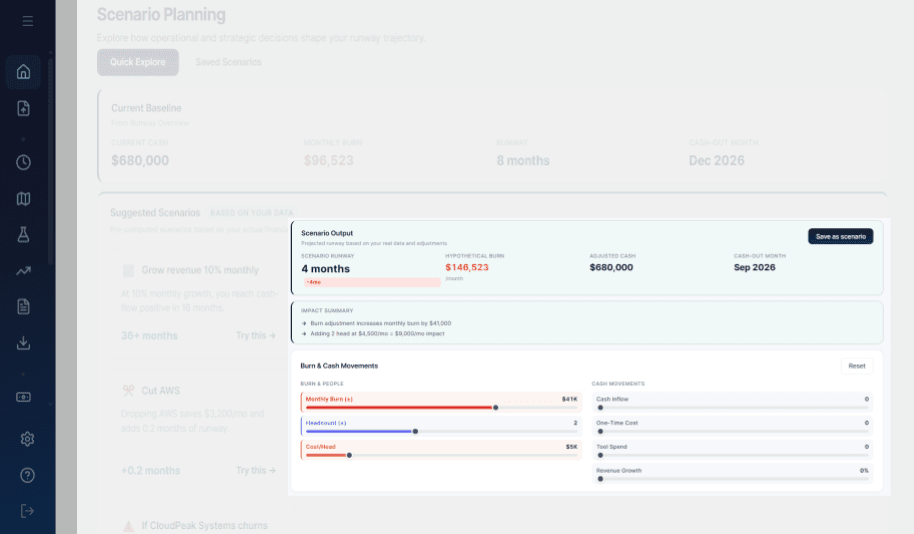
Product proof
Bring work, commitments, and cash into the complete financial picture.
Mission Control, Planner, Scenarios, and read-only reporting support the financial decision without turning RunwayCal into Logistics operations software.
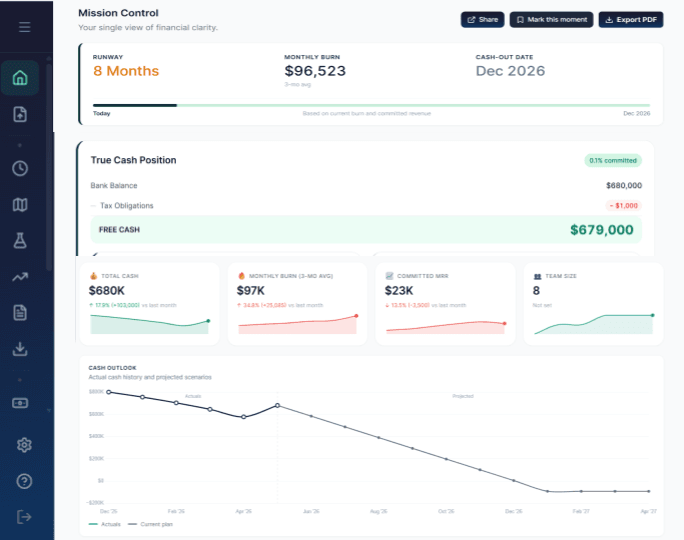
Primary product view · Mission Control
Start with the complete financial position.
Runway, monthly burn, cash-out date, True Cash Position, and financial context come together here. This is product evidence, not a fleet dashboard.
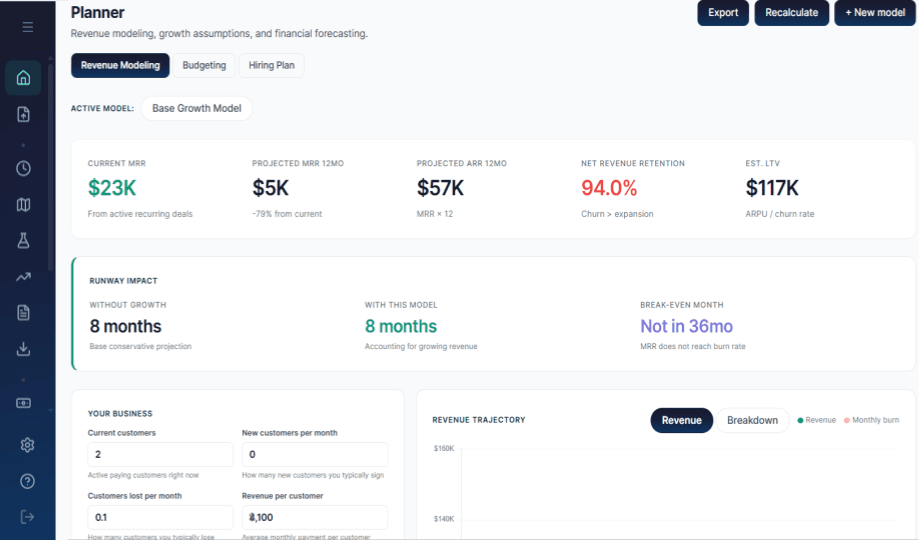
Planning evidence · Planner
Put capacity and cost assumptions into the plan.
The planning surface holds financial assumptions. It does not dispatch work, optimize routes, or manage vehicles.
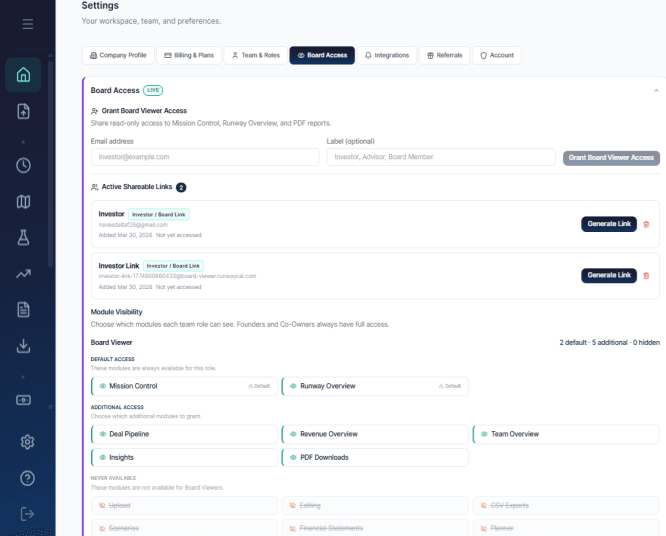
Reporting evidence · Board Access
Share a selected read-only view.
Read-only access and module visibility controls support reporting context without claiming Logistics-specific operations reporting.
Reporting & metrics
Use each measure to ask a sharper operating question.
Give owners, operators, and finance teams the context behind booked work, capacity, collection timing, commitments, and cash.
Explore reporting- Booked work
- Decision question: What customer work is already reflected in the operating plan?
- Planning context
- Available capacity
- Decision question: Can the business serve the work without a new commitment?
- User-reviewed
- Collection timing
- Decision question: When is customer cash expected, and what has arrived?
- Expected vs recorded
- Fuel and workforce
- Decision question: What changes when cost pressure moves above the plan?
- Planning assumptions
- Operating commitments
- Decision question: How much future cash is already spoken for?
- Planning context
- True Cash Position
- Decision question: What does the current position support after known obligations?
- Visible in product
The operating labels are planning context, not automated fleet metrics. No route, dispatch, tracking, telematics, or fuel-management capability is implied.
Keep planning
Take the contract question into the right planning view.
Move from capacity, operating pressure, and collection timing into the financial decision that needs review.
Know what the next contract asks of cash.
Connect collection timing, fuel, leases, maintenance, people, and commitments before new work becomes a fixed operating decision.