
Cash commitments and commitment planning
See what is already spoken for before you commit again.
Review known tools, contracts, payroll-related commitments, and other supported obligations before adding another cost. See the amount, timing, and renewal pattern in the same planning context as cash.
- Amount stays explicit
- Timing stays visible
- Payment stays separate
Illustrative planning geometry, not product UI.
Chapter 01
Start with what the business has already committed to.
Tools and software, annual renewals, recurring services, known contractual costs, and supported payroll commitments can all create pressure before cash leaves the business.
A commitment is a planning record. It is not automatically an invoice, an accounting liability, or proof that cash has moved. RunwayCal keeps that boundary visible.
Chapter 02
Amount is only half the question.
The same amount creates a different decision when it repeats weekly, monthly, quarterly, or once. Start and end dates define its active window. The next payment date shows when attention is needed.
Cash Commitments supports both inflows and outflows, so a refund or sublease receipt can remain distinct from a vendor payment. Direction changes the cash story without turning expected money into money received.
Chapter 03
A monthly bill and an annual renewal should not look the same.
Monthly-equivalent and annualized views make recurring cost pressure comparable. They do not erase the calendar. Quarterly, semi-annual, and annual commitments retain their real due periods in the forward cash view and due prompts.
This is planning treatment, not accounting recognition. The smoothed cost basis explains ongoing pressure; the due event shows when cash timing becomes immediate.
Planning example only. It does not describe accounting accrual.
Chapter 04
Keep known commitments visible before payment.
The current Cash Commitments surface summarizes Monthly outflows, Monthly inflows, Annualized, and Active. Each row keeps its name, amount, direction, category, cadence, next payment, and status in view.
Entries are manually controlled planning records. They can be edited, paused, completed, marked paid when due, or deleted. The product can prompt on due items and warn about likely duplicates; it does not run an AP approval or bill-pay workflow.
Chapter 05
A commitment can change the plan before cash leaves.
Active commitments feed the forward cash view and the smoothed burn context used for planning. That lets the business see the consequence of a known obligation without pretending the payment has already happened.
One-time commitments land in their dated month. Recurring items continue across their active window. Inflow commitments remain separate from realized receipts and from canonical revenue.
Explore Runway OverviewChapter 06
Smoothing the plan should not erase the real due month.
A planning average answers how much pressure the commitment adds. The due date answers when cash must be ready. Both are needed for a sound decision, especially when a large annual renewal sits inside an otherwise steady monthly plan.
Due prompts and payment history help the operator act on timing. They are not automated payments, invoice approvals, or bank reconciliation.
Chapter 07
See what is spoken for before judging what cash can support.
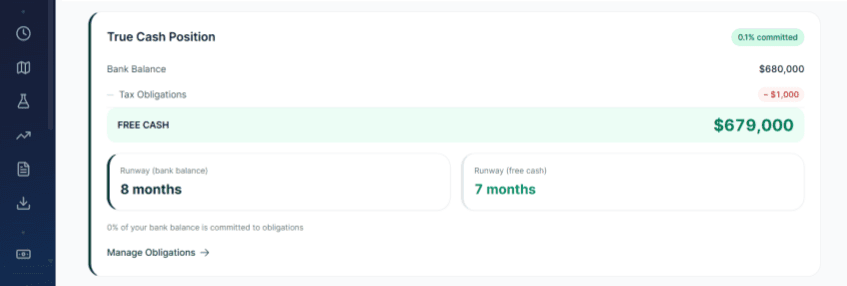
Commitment Planning explains one source of future cash pressure. Cash Flow brings that pressure together with held cash, received money, and timing. True Cash Position adds product-owned decision context without reducing the relationship to a marketing formula.
The result is not an accounting ledger or a bank balance. It is a clearer view of the commitments already competing for future cash.
Chapter 08
Know the pressure already in the plan before adding another commitment.
Renew the software, add the vendor, move the payment, delay the purchase, or keep the commitment. RunwayCal shows the timing and financial consequence. The operator still makes the decision.
The existing pressure and timing leave enough room.
A later due date changes the pressure without hiding the cost.
A scenario can show the consequence before canonical data changes.
Commitment planning
See what is already committed before you commit again.
Keep known obligations and their timing visible before the next spend becomes another fixed part of the plan.