
Keep funding separate from customer revenue.
Angel capital and customer receipts answer different questions. Funding can change the cash position after it lands, but it does not prove recurring revenue, collection performance, or demand.
Angel funding planning
Put the amount and timing beside hiring, spend, and runway before you accept the next commitment. Keep new capital separate from customer revenue, compare the choice as a scenario, and see how much room the business actually gains.
Planning explanation only. No cap table, legal terms, or investment advice.
The job
Angel funding adds capital to the business. It can extend runway, but the hiring and spending choices that follow can shorten it again. RunwayCal helps a founder test that operating trade-off. It does not find investors, calculate cap-table terms, or provide legal, securities, or investment advice.
From question to decision
Angel capital and customer receipts answer different questions. Funding can change the cash position after it lands, but it does not prove recurring revenue, collection performance, or demand.
A larger balance may create room, but payroll and commitments consume that room month by month. Put the intended uses beside the round so the founder can see what remains after the plan begins.
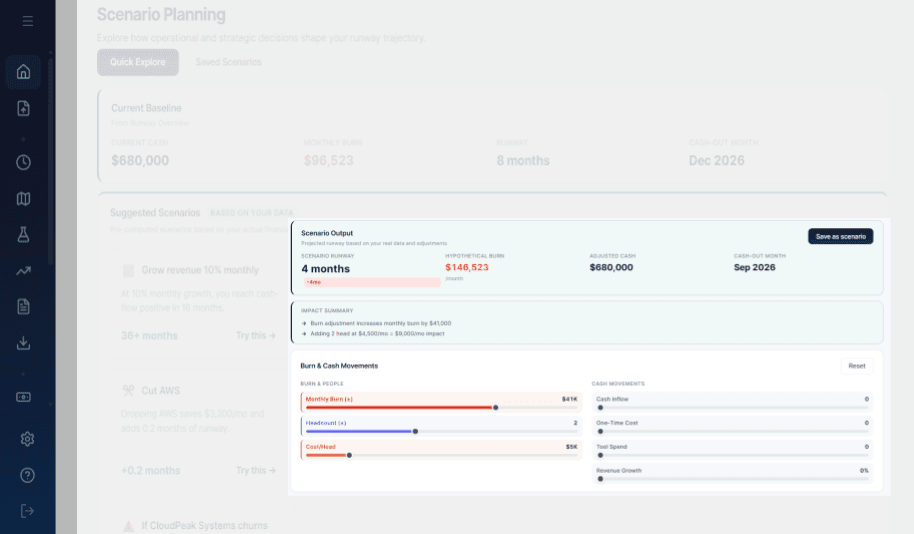
Use a scenario to change the amount, arrival date, hiring pace, or spend assumption. The result stays hypothetical and separate from Treasury, recorded funding, receipts, payroll, and the current runway.
Compare what the round makes possible with what it commits the business to carry. Ownership and dilution terms remain part of the founder's legal and financing process, outside RunwayCal's planning calculation.
See it in RunwayCal
Scenarios let you compare a funding, hiring, or spend assumption with the current position. They do not calculate investment terms, ownership, or dilution.
Keep the distinctions intact
Angel funding
Keep funding, operating choices, and runway consequences separate and visible.