
Dental Practices
Treatment · Responsibilities · Collections · Practice costs
Plan the practice around when cash actually arrives.
Treatment, patient responsibility, insurer responsibility, staffing, equipment, and recurring costs move on different clocks. Keep expected money separate from recorded receipts before changing the practice plan.
Dental financial reality
Treatment and cash collection happen on different clocks.
The appointment and treatment may be complete while patient and insurer portions are still expected. The cash plan needs that timing without pretending to run clinical or claims operations.
Illustrative treatment-to-cash path
Treatment and collection happen on different clocks.
care delivered ≠ cash received
- 01
Appointment
The planned visit creates operating context
- 02
Treatment delivered
Care happens before every payment arrives
- 03
Amount due
The expected amount remains separate from cash
- 04
Responsibility
Patient and insurer portions can follow different timing
- 05
Collection timing
Received and expected amounts stay distinct
- 06
Cash
Recorded receipts reach the financial position
Practice commitments
- Staff payroll
- Lab and supplies
- Equipment
- Rent
- Recurring tools
Responsibility split
Amount due is not the same as cash received.
Keep patient and insurer portions visible as planning context. Record what has arrived, preserve what is still expected, and do not treat either responsibility as automatic receivables data.
Illustrative responsibility split
example only
- Treatment amount
- $1,200
- Illustrative amount due
- Patient responsibility
- $300
- Separate expected portion
- Insurer responsibility
- $900
- Separate expected portion
- Received
- $300
- Recorded cash received
- Still expected
- $900
- Not cash until received
Practice commitments
Known costs keep moving while collections are open.
Staff payroll, lab work, supplies, equipment, rent, and recurring tools can become fixed before expected money arrives.
Staff payroll
Provider and support-team cost keeps its own schedule
Lab and supplies
Orders and vendor timing can move before collection
Equipment
Purchases, leases, and financing can become fixed
Rent and tools
Recurring practice costs continue every month
Practice capacity
See what growth asks of cash before expanding capacity.
A new provider, team member, chair, or location can create cost before related collections begin. Keep the commitment and expected timing together.
- 01
Treatment capacity
What can the current practice team support?
- 02
Staffing / equipment need
What must change to expand capacity?
- 03
Commitment
What cost becomes fixed and when?
- 04
Expected collection timing
When could related cash actually arrive?
Know what staffing and equipment ask of cash before expanding capacity.
Practice and group context
Review the group without flattening each practice.
Each practice remains financially visible. Collection timing and costs can differ, while leadership reviews the combined position and returns to the source location for local action.
Illustrative practice context
Keep each practice visible inside the group view.
Collection timing and commitments can differ by practice. Leadership can review the group without flattening the local question.
Practice A
Collection timing moved later
Practice B
Staffing commitment begins next month
Practice C
Equipment cost enters the plan
Conceptual relationship · not product UI
Practice A
Local context retained
Practice B
Local context retained
Practice C
Local context retained
Combined financial context
Review the group, then return to the practice creating the question.
Conceptual multi-location relationship, not a RunwayCal screen. The real Mission Control capture below shows the financial context the product makes visible.
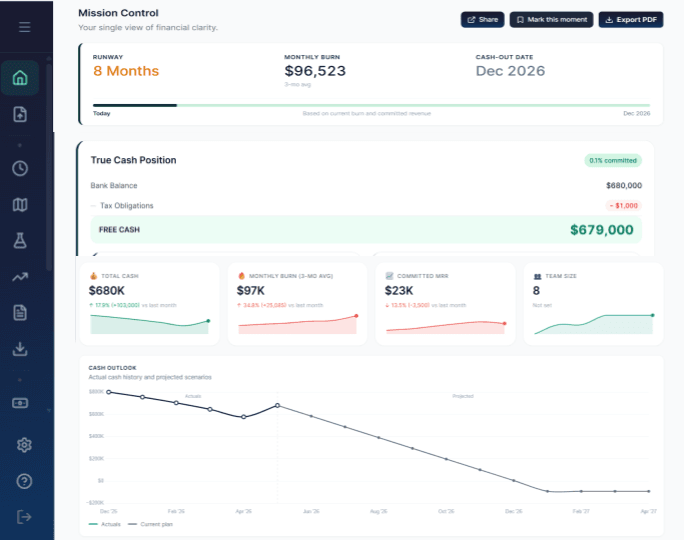
Inside RunwayCal · Mission Control
Bring the collection question back to cash and runway.
The product connects the current financial position, commitments, and runway context without replacing dental billing or clinical systems.
Variance and scenarios
See what changed before changing the practice plan.
Review treatment activity, collection timing, staffing, lab and supply cost, equipment timing, and location movement. Then test a separate scenario without changing the recorded result.
- Plan
Approved assumptions
- Actual
Recorded period
- Variance
Difference retained
- Next action
Review and decide
Treatment activity
- Plan
- Approved activity assumption
- Actual
- Recorded period result
- Variance
- Difference retained
- Next action
- Review treatment-volume assumption
- Status
- Needs review
Collections
- Plan
- Expected collection timing
- Actual
- Recorded cash received
- Variance
- Difference retained
- Next action
- Review patient and insurer timing
- Status
- Needs review
Practice cost
- Plan
- Approved staffing and supply budget
- Actual
- Recorded period cost
- Variance
- Difference retained
- Next action
- Review staffing, lab, supply, or equipment timing
- Status
- Needs review
Staffing capacity
What does another provider or team commitment ask of cash?
Equipment commitment
What changes if the equipment cost begins earlier?
Location expansion
Can the group carry another location before collections ramp?
Collection timing shift
What happens if expected cash arrives later?
Illustrative scenario questions, not presets, clinical recommendations, or autonomous decisions.
Decision questions
Keep treatment, responsibility, collections, and cash distinct.
RunwayCal supports financial planning. It does not claim practice management, insurance verification, claims adjudication, patient records, clinical workflow, or HIPAA compliance.
- Treatment activity
- Decision question: Did activity differ from the approved plan?
- Recorded vs plan
- Patient responsibility
- Decision question: What patient portion is expected, and what has been received?
- User-recorded
- Insurer responsibility
- Decision question: What insurer portion remains expected rather than received?
- User-recorded
- Practice commitments
- Decision question: Which staffing, lab, supply, equipment, and recurring costs are fixed?
- Planning context
- Location context
- Decision question: Which practice is creating pressure inside the group picture?
- Multi-location context
- Runway
- Decision question: How does the current cash and commitment position carry the practice?
- Visible in product
Keep planning
Take the practice question into the right planning view.
Move from collection timing and practice commitments into the financial decision that needs review.
Plan the practice with collection timing in view.
Connect treatment activity, patient and insurer timing, staffing, equipment, and recurring commitments before the next practice decision.