
Runway Compression
Runway compression is a reduction in expected runway caused by changes in cash, spending, obligations, receipt timing, or the assumptions used in the cash path.
One large event can compress runway, but several smaller changes can have the same effect. The prior runway figure was conditional on its inputs, not a promise.
Runway compresses when the revised cash path reaches its defined floor sooner. The useful follow-up is to identify which recorded movement, commitment, timing change, or assumption changed the path.
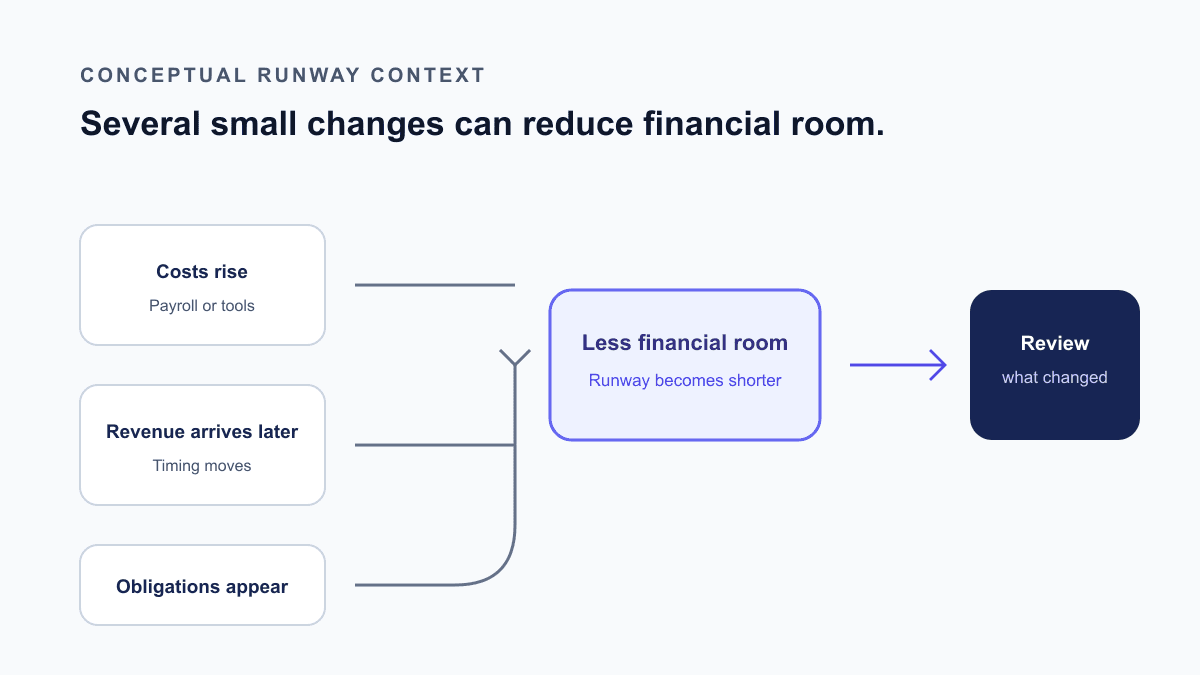
Conceptual explanation: several business changes can shorten runway together.
What is Runway Compression?
Runway compression describes a shorter expected runway compared with an earlier reviewed position or baseline. It can result from lower starting cash, higher or earlier outflows, new obligations, slower or smaller receipts, a changed burn pattern, or a correction to the underlying data.
The change can be sudden, such as a major unplanned payment, or cumulative, such as several hires, renewals, and delayed customer receipts. A small change in several months can materially alter the point at which the modeled cash floor is reached.
Compression does not mean the earlier calculation was a promise that failed. Runway is conditional on the available evidence and assumptions at each review date. Reconcile the old and new positions before drawing a conclusion.
What can compress runway?
Recorded movement
Lower cash, higher realized outflows, or smaller realized inflows change the starting evidence.
New obligation
Payroll, tax, software, vendor, debt, or another commitment can add forward pressure.
Timing or assumption change
A delayed expected receipt, earlier payment, or revised operating assumption changes the modeled path.
Compression versus an operating crisis
A shorter runway deserves review, but it is not automatically a crisis. The amount of remaining cash, financing horizon, operating flexibility, revenue and collection context, obligations, and management options determine the response.
How should the change be explained?
Bridge the prior position to the current one. Separate movements that already occurred from commitments, planned changes, expected receipts, and hypothetical Scenarios. This shows whether the compression came from reality, timing, or a changed assumption.
Why it matters
A business can lose financial room through several ordinary changes even when no single event looks decisive. Seeing the bridge early creates more time to investigate collections, commitments, hiring, discretionary spending, financing preparation, or a separate alternative Scenario.
The goal is not to react to one headline. It is to understand what changed, whether the current path is supported, and which decisions remain available.
What goes into it
- Prior and current cash positions under the same scope
- Recorded inflows and outflows since the prior review
- New or changed commitments and their dates
- Expected, planned, and Scenario changes kept separate
Illustrative runway bridge
A business previously reviewed 14 months of runway. Payroll rises, an annual software renewal becomes due, and a large expected receipt moves two months later. No single change exhausts cash, but the revised path reaches the defined floor earlier. The bridge shows which pressure is recorded, committed, or still expected.
How RunwayCal helps
Runway Overview keeps the current cash path connected to supported inputs and timing, while Mission Control can surface the wider operating context. Scenarios test an alternative without rewriting the current position.
RunwayCal provides deterministic calculations from supplied inputs. It does not predict an operating crisis or recommend a specific corrective action.
Common mistakes
- 1Treating the prior runway as a fixed promise.
- 2Ignoring several smaller changes because none looks decisive alone.
- 3Mixing recorded movement with expected and hypothetical changes.
- 4Reacting to the headline without reconciling the underlying path.
- 5Calling every shorter runway an operating crisis.
Get the Financial Clarity Newsletter
Practical tips on cash flow, runway, and financial decisions for founders, business owners, CFOs, investors, and board members. Free, weekly, no spam.
See what changed the runway path.
Trace the recorded movements, obligations, and timing changes that reduced the current financial room.
Explore Runway Overview